The integration of Arts in STEM (Science, Technology and Engineering and Maths) education is one of the main objectives of the European Union. Furthermore, most European schools are multicultural with students from diverse cultural, socio-economic and religious backgrounds. Consequently alternative approaches are being adopted to motivate and engage students towards a more inclusive education. Both Arts integration in STEM and multicultural engagement are an important innovative of the M2-Cm project. A third important innovation is to employ music and creative movement to confront Maths phobia that a lot of students (and also adults) experience. ”Math Phobia may be a feeling of tension, apprehension, or fear that interferes with math performance. An individual with math phobia doesn’t necessarily lack ability in mathematics; rather, s/he can’t perform to her/his full potential thanks to the interfering symptoms of anxiety..”

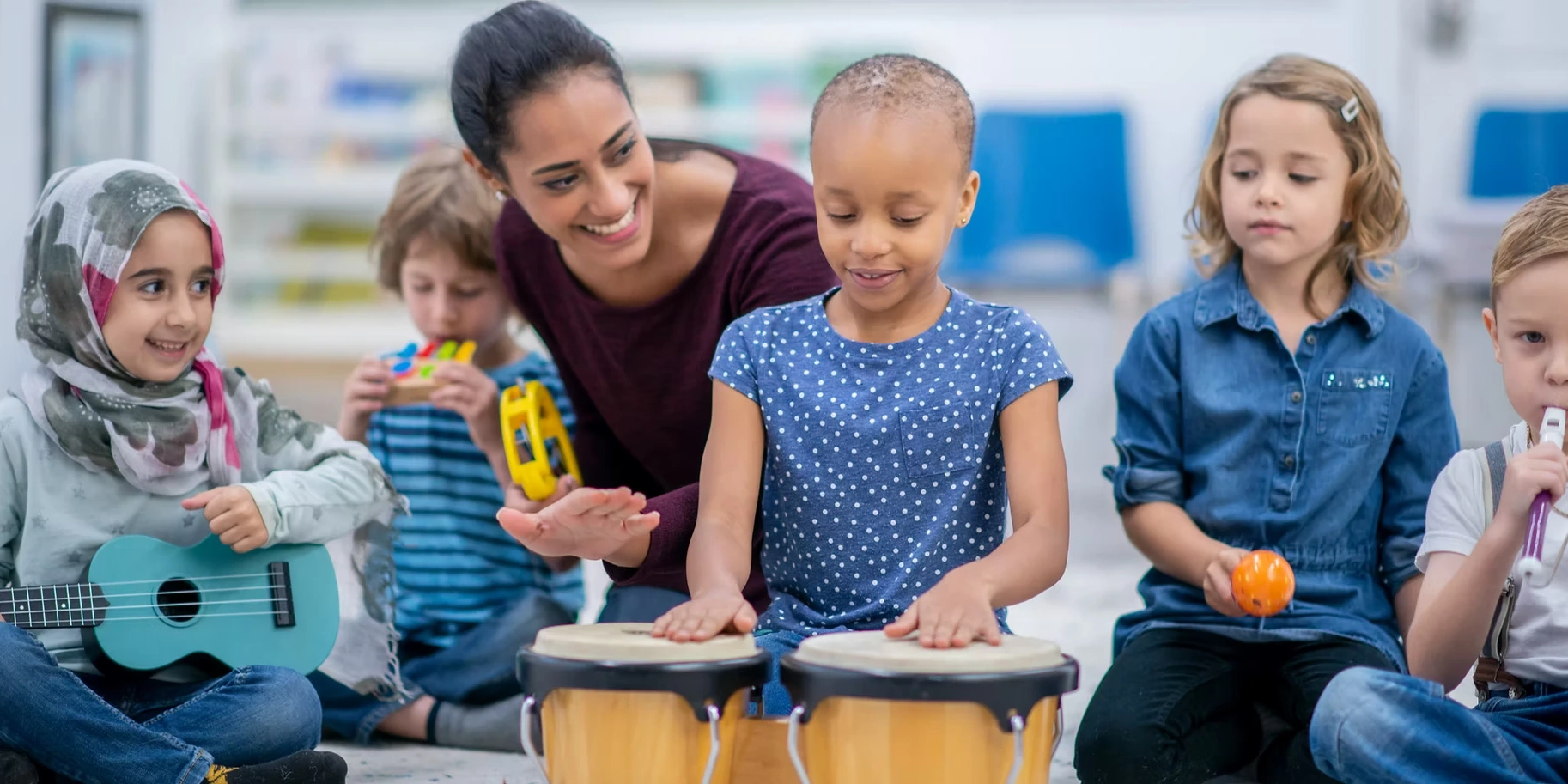
Among the suggested methods that can be used as remedy for the Maths Phobia is to be shown to children that math is a creative subject. Learning math is very much like learning music or art! Thus, the integration of Music and Creative Movement into Maths learning procedure brings more fun and interaction among students and teachers that leads to positive academic results.

In Viksjöforsbaletten for more than a decade the local dance teachers have supported learning curricular subjects with cultural expressions in the dance school. AMusEd is an organization that gives special emphasis in the importance of integrating music in curriculum subjects. Both organizations acknowledge the importance of integrating arts into curriculum subjects, and they have experienced first hand the positive effects of it on students’ wellbeing and academic results.

Music and Creative Movement are inseparable and they directly connect with the embodied cognition philosophy, since through Creative Movement and Music we can help learners receive and gain new knowledge through their engagement of their whole body (embodied cognition). TUC/MUSIC as a technological University gives special attention in the development of STEAM competencies in young people, that will help them not only during their student life but also in their future life as adults for that it participated in several Erasmus+ projects and focuses on innovative pedagogical approaches integrating Arts and promoting STEAM in European Schools.

Mavromataki Private school is also focusing on the STEAM approach and more specifically in the connection of Maths with the other school subjects since Maths is a foundation in all professions and activities in people’s lives.

All involved partners bring a different expertise in this project and they all have special interest in promoting the STEAM approach, elements that will bring added value to the implementation of M2-Cm project. We strongly believe that the Production of Project Results will help teachers to gain new knowledge that will improve their teaching skills in STEAM approach and the students, who are the final beneficiaries, will be introduced to a more effective way of learning Maths.

Through this project we aim to achieve the following:

  • Enhance STEAM pedagogical competences in the field of integrating arts in mathematics;
  • Enhance skills and efficacy in music and creative movement;
  • Adopt innovative teaching methods by embracing the effective use of music and movement techniques;
  • Increase students’ motivation and engagement in the learning process, fostering creativity and critical thinking through a more experiential approach of learning;
  • Create a positive classroom environment, by enhancing team building and collaboration that contribute to learners’ wellbeing;
  • Increase awareness of the effective integration of music and creative movement in Maths across Europe.

The specific project results to be produced are:

Teachers Guide
This guide includes research done that proves the relevance and the importance of music and creative movement in Maths within the overarching framework of STEAM teaching and learning. Further, it transfers to the teachers the general theoretical knowledge of Music and Movement that matches the Mathematical concepts as well as the historical and intercultural connections of these three subjects. The Teacher Guide is offered in English, Swedish and Greek.

Repository of activities and other useful sources for the teachers.
Examples of activities that can be directly implemented in real classrooms, step by step guides on how to create a song that brings an added value to the class, sources where teachers can find similar examples from all over the world as well as a repository of world music/dance that can be connected to mathematical concepts and examples that can be used for the purpose of enhancing the integration of arts in Maths. The activities in the repository are offered in English and, whenever possible and necessary, in Swedish and/or Greek.

Online Networking and e-learning Platform.
The aim is to bring and network teachers across Europe in order to enable them to exchange ideas and practices in Maths teaching and give them the opportunity to be educated in an online environment and see a lot of examples of activities in real classrooms.

Apart from the planned Project Results that are tangible, some intangible outcomes are achieved through M2- Cm. These outcomes are:

  1. Expansion of the partners’ knowledge as it concerns didactic methods applied in Maths.
  2. Improvement of management skills in European projects and possibility for future collaborations.
  3. Increased motivation of students to learn.
  4. Increased intercultural awareness. Through music examples participants will have the opportunity to learn about others’ countries’ music culture.
  5. Contribution to the professional development of participating educators.
  6. Help students to cross barriers. Students who are not familiar with Music or Movement (dance) are given a route into these Arts or students who are shy with Maths will find a new way to experience it.
  7. Improvement of students’ reaction towards Maths subject.
Partners

  • Viksjöforsbaletten (Viksjöfors - Sweden)

    Viksjöforsbaletten is located in distant isolated Swedish countryside. The cultural voluntary organization was founded 1989.  There has over the years been focus on cultural expressions (choreographies), physical creativity (dance), alternative learning (non-formal and in-formal), freetime choices (activities evenings, weekends and holidays), offering alternative learning methods in schools (learing curricular subjects with cultural expressions) and integration (dance and disability). For newly arrived refugees we offer alternative languages in learning (bodylanguage/expression via dance/achrobatics/parcour, music, film, art, drama/theater etc.).
    In the area of countryside forestry there is by tradition low ambition for education due to early age in work within farming, forestry and factories (forest machinery and furniture). Girls tend to leave already at upper secondary level while boys tend to stay and stick to fishing/hunting, motor sports and computer activities. This is a reason for new mixed families (Asia-Swedish, Afro-Swedish).

    Viksjöforsbaletten is situated in the garden of the local school, 10m from house corner to house corner. It is not only the location but the spirit for artistic values in the village that gives artistic expressions a special value. Since foundation in 1998 the school and the dance school act in cooperation. When dance teachers work in Viksjöforsbaletten they naturally are connected to the school kids as well in school hours as in after school activities. In this spirit there was developed a concept of approaching curricular subjects with cultural expressions in considerable support from various programmes in the European Union.

  • Technical University of Crete (TUC/MUSIC - Greece)

    TUC/MUSIC was established in 1990 in the Dep. of Electronics and Computer Engineering of the Technical University of Crete, Chania, Crete, Greece. It is a centre of research, development and teaching in the areas of distributed information systems, application engineering, computer graphics, and simulation engineering. TUC/MUSIC performs research in the areas of high performance distributed multimedia architectures, information systems offering advanced functionalities, data base systems, information retrieval systems, digital libraries, service oriented architectures, and graphics systems. In the area of application engineering, TUC/MUSIC performs research in the topics of large distributed multimedia delivery networks for intelligent TV applications, semantic interoperability infrastructures, web and mobile based application development methodologies, natural language processing, as well as standard-based software infrastructures for multimedia applications in areas such as e-learning, culture and tourism, business applications, TV Applications and medicine. It also has extensive experience in usability aspects of modern applications, the design of intuitive and efficient graphical user interfaces both for the desktop and the web, and their evaluation following standard methodologies.

    The last 6 years, TUC participates in a number of projects (ALICE, e-ARTinED, MultiLib) focusing on the integration of arts into formal and non-formal learning settings. Based on the experience from these project TUC will lead the work regarding the set up of an infrastructure to promote the use of arts for social inclusion in schools and will also involve local schools in the pilot activities of the project.

  • Amalgamate Music Education (AMusEd - Cyprus)

    Amalgamate Music Education – AMusEd is a Small Enterprise located in Strovolos in Nicosia. AMusEd was established in 2018 and it offers a variety of music lessons in Cyprus. It offers early childhood music lessons for children 0 – 6 years to family, nursery and kindergarten settings in Nicosia. Further, there is a wide range of private instruments lessons offered in its premises. The lessons offered are piano, guitar, ukulele, recorder, clarinet, saxophone, vocals, violin, cello, and flute. AmusEd provides also educational courses in the field of music education and the integration of music into curriculum subjects to in-service teachers in Cyprus, through the Pedagogical Institute of Cyprus and other organizations. AMusEd is a course provider of educational courses in the field of arts in general (music, theatre and visual arts) funded through Erasmus+ KA1.

    As an offer to the community, AMusEd has organized a multicultural band and a Gospel choir which members are mainly people from Africa who live in Cyprus in status of Asylum Seekers. As an organization who listens to the needs of the community and also recognizes the added value that music brings to people’s lives, AMusEd has set up Drums Circle groups where ‘mainly adults’ from different backgrounds join and make music together. Also, since 2020 they have been organizing group sessions and events that enhance the general quality of people’s lives. Such courses are “Creative Writing Workshops”, “Informal Cyprus Dialect lessons to migrants”, “Ukulele nights for adults”, “Creative workshops for children”, “Music Courses” and “Specialized music seminars”.

    Finally AMusEd is now getting into the corporate world offering non formal music course to business with the aim to improve teambuilding, Collaborative work, and connect music factors with the business world.

  • Mavromataki - Mitera Private School (Mavromataki - Greece)

    Mavromataki Private School is a small, private primary school located in Chania, Crete, Greece. It has around 45 students aged 6 to 12 and 14 teachers. Its aim is to create a school environment that helps students grow educationally, socially, and culturally by participating in innovative projects that combine learning with fun.

    The profile of the school has diversified over the last few years to offer pupils more opportunities for their future endeavors. This includes IT lessons from a specialist IT professor, Robotics and Coding, and STEAM education. Emphasis is placed on the inquiry-based method of learning and real-life problem-solving. In particular, Mathematics is connected with all other school subjects through hands-on activities, tinkering, and the arts, such as music, dance, and art lessons.

    The school is bilingual in Greek and English, hosting a multicultural community with students from different regions and cultures. Besides the Greek students, many others are native English speakers from the USA, alongside a substantial number of students with parents from various EU countries. Every year, the school takes part in many local, national, and international projects—especially the Erasmus+ program—seeking new opportunities to expand its horizons. It focuses on younger ages, looking for innovative ways and methodologies to reinforce the bottom-up progression of an active European citizen identity.